


Public officials are concealing essential financial documents from scrutiny Rivers Administrator.
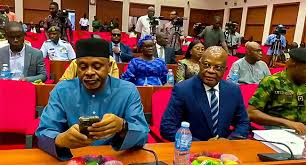
The Sole Administrator of Rivers State, Vice Admiral Ibok-Ete Ekwe Ibas, defended the N1.4 trillion budget before the Senate’s ad-hoc committee on Thursday. He emphasized that emergency rule should not replace democratic governance, according to the Senate’s statement. Ibas also insisted on the importance of tracking how allocated resources are utilized.
Additionally, he revealed that some officials within the state government withheld essential financial records necessary for documenting the expenditures incurred by the state in the first quarter of 2025.
However, the Leader of the Senate and Chairman of the Senate Ad-hoc Committee on Oversight of Emergency Rule in Rivers State, Senator Opeyemi Bamidele, observed that emergency rule “is not a replacement for democratic government, but an extraordinary measure to ensure peace and security in Rivers State.”
Two top officials shared their opinions yesterday during the defense of the 2025 Appropriation Bill before the Senate Ad-hoc Committee on Oversight of Emergency Rule in Rivers State, held at the New Senate Building in the National Assembly Complex in Abuja.
President Bola Ahmed Tinubu had declared a state of emergency in Rivers State, citing the prolonged political crisis in the region and its impacts on national economy and security.
In response, the President of the Senate, Godswill Akpabio, established an 18-member Committee on Oversight of Emergency Rule in Rivers State, led by Senator Bamidele.
The ad-hoc committee consists of key Senate members, including Chief Whip Senator Tahir Munguno, Deputy Chief Whip Senator Peter Nwebonyi, and Chairs of various committees such as Senators Adamu Aliero (Land Transport), Sani Musa (Finance), and Adetokunbo Abiru (Banking and Insurance).
While defending the 2025 Rivers State Appropriation Bill on Thursday, the sole administrator acknowledged that the budget proposal may not be perfect due to the time and circumstances of its development.
Unfortunately, Ibas noted that some state officials did not provide critical information necessary for a more comprehensive understanding of the expenditures made in the first quarter during the submission of the budget estimates.
However, the sole administrator mentioned that the budget being considered aligned with the strategic objectives set forth in the Rivers State Development Plan (2017-2027).
He stated that the budget estimates presented “an integrated framework to strengthen revenue mobilization, accelerate infrastructure delivery, enhance human capital, and promote inclusive economic growth.”
“The budget is designed as a people-centered fiscal plan that addresses current challenges and future needs. We believe its implementation will bring significant socioeconomic benefits to the people of Rivers State.
During the budget defense on Thursday, Bamidele stressed the ad-hoc committee’s commitment to ongoing oversight of the state until the emergency rule is lifted. He clarified that emergency rule is not a substitute for democracy but a necessary measure to restore order and stability, in line with Section 305 of the Nigerian Constitution.
Furthermore, Bamidele highlighted that the Senate has tasked the ad-hoc committee with monitoring how budget funds will be utilized for the benefit of Rivers State residents.
“As representatives of the people, our role goes beyond evaluating figures; we must ensure proper budget execution. We are responsible for tracking how resources are used, ensuring transparency and accountability in public funds.
Our engagement with the Rivers State 2025 Appropriation Bill will continue as we monitor disbursements, timelines, and outcomes in the coming months. Our goal is to ensure that approved funds lead to meaningful development and that any issues are addressed quickly.
We also need to assess the budget’s real-world impact on the lives of Rivers State residents. In uncertain political times, government actions must be lawful and people-centered.
We must ask: Will this budget provide better roads, healthcare, education, safety, and livelihoods? Building trust in government comes from delivering tangible benefits to citizens. When they see real improvements, their faith in governance is renewed. It is our duty to strengthen this trust through our recommendations and ongoing vigilance,” the chairman of the ad-hoc committee explained.
